01 / PROPULSION
Research question: electric propulsion performance and integration limits. Evidence: field-topology literature review. Constraints: power, mass and thermal budget. Stage: exploratory research.

SYSTEMS ARCHITECTURE / INTERFACE STUDY
Power, sensing, electronics, and control are connected by constraints. Explore the architecture and the questions its interfaces create.
Explore four linked disciplines. Select a subsystem to inspect its research question, evidence, interfaces, constraints, and next engineering milestone.
Research question: electric propulsion performance and integration limits. Evidence: field-topology literature review. Constraints: power, mass and thermal budget. Stage: exploratory research.
Research question: how interchangeable subsystems maintain coherent interfaces. Evidence: architecture work; no integrated hardware test. Constraints: power, protocol compatibility and fault handling. Stage: architecture research.
Research question: how modeling assumptions affect feasible motion and feedback. Evidence: analytical X-drive control manuscript and numerical integration. Stage: analytical model.
Research question: how power, mass, data, control and verification requirements propagate across subsystems. Evidence: early architecture concepts. Stage: conceptual architecture.
Interfaces are constraints: sensing, estimation, computing and physical response belong to one engineering conversation.
VIEW THE RESEARCH RECORD ↗Four interconnected disciplines. One integrated engineering philosophy.
Research into electric propulsion, high-energy systems, and the integration of propulsion architectures with aerospace platforms.
Exploration of interoperable electronic architectures, sensing, communications, and electronic-warfare-resilient system design.
Research into geometric control, state estimation, sensor fusion, and reliable operation under uncertain conditions.
Developing system-level architectures that connect propulsion, electronics, sensing, control, and aircraft design.
Two connected research directions, illustrated through original Exodus-branded concept artwork.
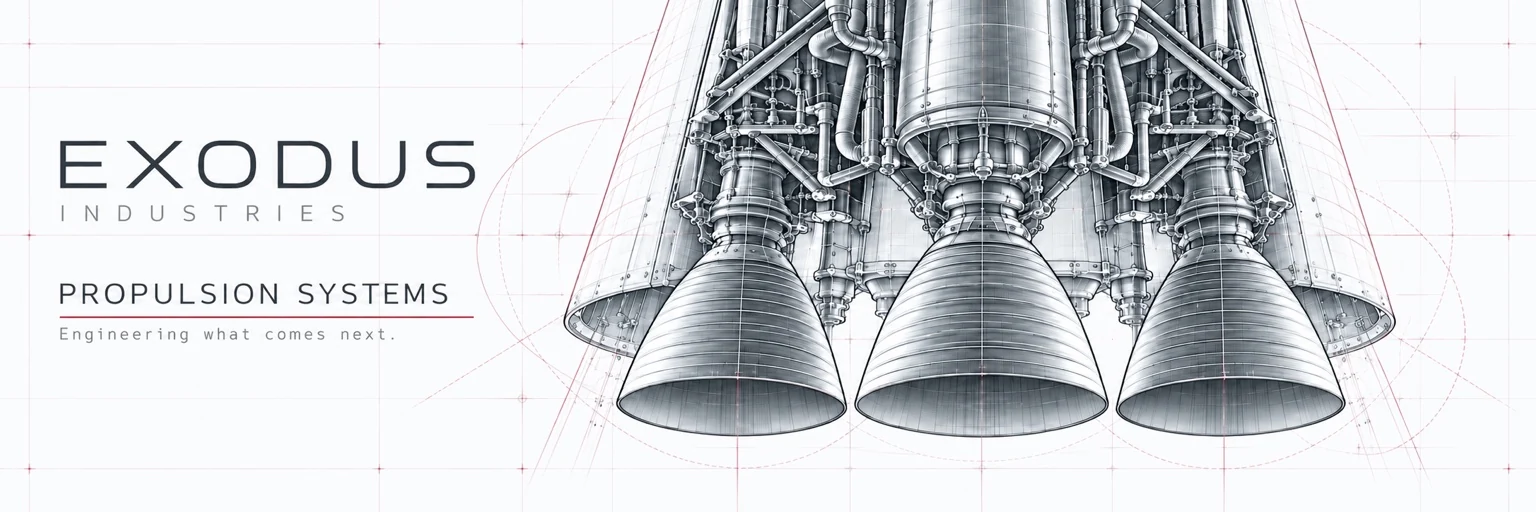
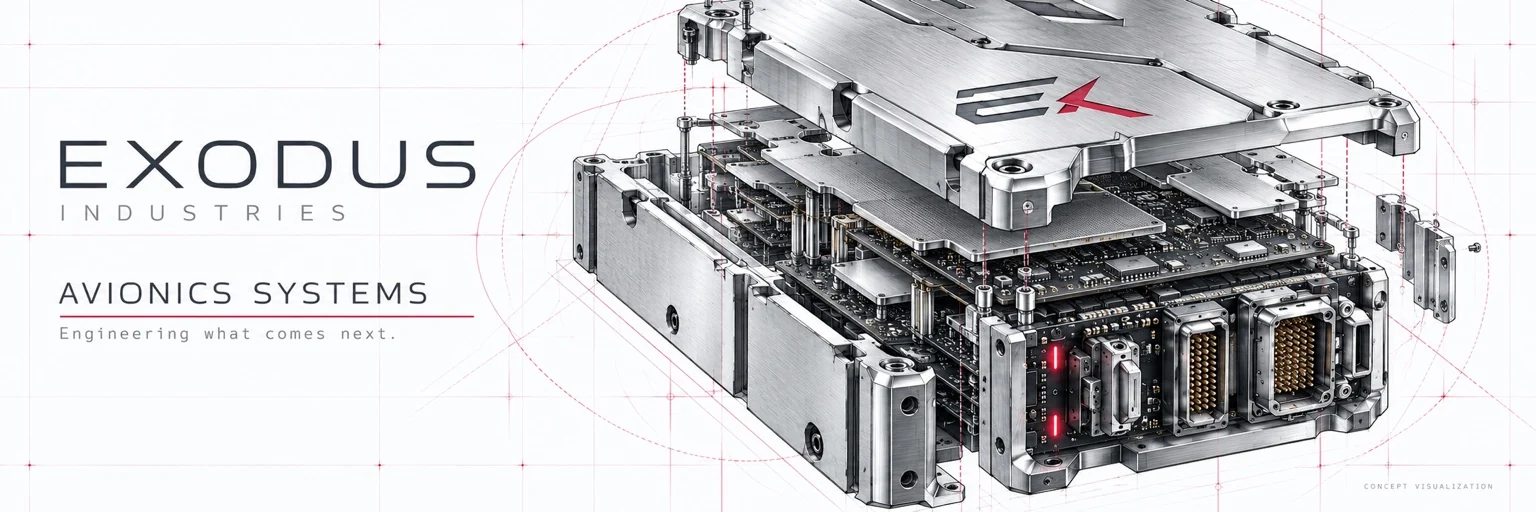
Electronics, sensing, control, and propulsion meet at interfaces where assumptions must be specified and tested. Exodus studies those interfaces as an integrated architecture problem.
VIEW ENGINEERING PROGRAMS ↗Read the underlying mathematical and physics research manuscripts.
Explore the next engineering perspective.